HDPE Pipes for Water Resources | Reliable Water Transmission Solutions

Managing water efficiently, whether for agriculture, municipal supply, or industrial use, depends heavily on the quality of the pipeline system. One solution that has become the clear favorite among engineers, planners, and government departments is water resources HDPE piping. If you’re looking for long-lasting, safe, and cost-effective water distribution systems, HDPE pipes are one of the most reliable choices available today.

What Are Water Resources HDPE Pipes?

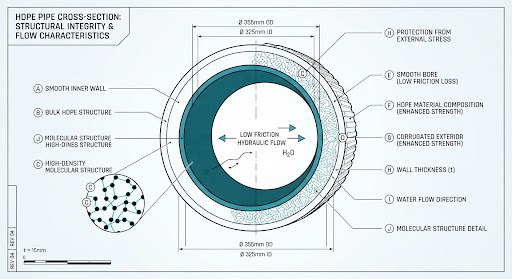
Water resources HDPE (High-Density Polyethylene) pipes are specialized piping systems designed to transport water safely across long distances under varying pressure conditions. Unlike metal or concrete pipes, HDPE pipes do not corrode, rust, or crack due to soil shifts. This makes them ideal for building water networks that must remain functional for decades with minimal maintenance.

Why HDPE Pipes Are Ideal for Water Resources Management

Here are the key benefits that make HDPE pipes a popular choice for water resource projects across India:

1. Long Service Life

HDPE pipes are highly resistant to chemical corrosion, environmental stress, and abrasion. They maintain performance even in aggressive soil or challenging terrains, resulting in reduced replacement cycles and long-term cost savings.

2. Flexible Yet Strong

Flexibility may sound like a weakness in pipes, but in the real world, it’s a major advantage. HDPE pipes can bend around obstacles, absorb soil movement during monsoons, and handle uneven topography without cracking. This flexibility drastically reduces leakage risks in comparison to rigid materials.

3. Leak-Proof Joints

HDPE pipes are connected using heat fusion techniques, creating a single continuous pipe system without weak joints. This is extremely important for water resources because every leak represents a loss of treated or stored water. Fusion joints significantly improve efficiency and reduce water wastage.

4. Lightweight and Easy to Install

HDPE pipes are much lighter than concrete or steel pipes, which simplifies handling and installation. They require less machinery and manpower, lowering project timelines and implementation costs. This makes them especially useful for rural water supply and agricultural irrigation networks.

5. Safe for Drinking Water

HDPE is a potable-water-safe material that doesn’t leach contaminants into the water. For drinking water projects, this safety factor is a major requirement and one of the reasons many municipal bodies prefer HDPE over traditional materials.

Applications of Water Resources HDPE Pipes

From rural irrigation to high-pressure municipal transmission, HydroStruct HDPE adapts to any hydraulic requirement.

Versatility

  • Author image
    Agricultural irrigation systems
  • Author image
    Drinking water pipelines
  • Author image
    Rural and semi-urban water supply networks
  • Author image
    Long-distance pressure water transmission
  • Author image
    Groundwater recharge systems
  • Author image
    Industrial water circulation lines

Final Thoughts

If your goal is to create a water distribution system that performs reliably, resists environmental challenges, and stays cost-effective over time, HDPE pipes for water resource applications are a smart and future-proof choice. It combines durability, safety, and performance, three qualities every water management project needs to succeed.